ESOL/IEP helps students get language skills for life
By Sylvia Hernandez
Pulse Staff Reporter

Who needs expensive marketing tactics when word-of-mouth advertising can do the job? The Intensive English Program at Palo Alto College has experienced a boost in enrollment every year thanks to satisfied students who are getting the word out.

There are a variety of reasons why individuals enroll in English development courses. According to Margarita McAuliffe, Lead Instructor of English for Speakers of Other Languages, some students know little to no English and want to learn so that they better their chances of employment. Others want to be able to improve communication with their kids. A number of students just want to be able to function more fully in the community.

Students in the Intensive English Program include teenagers, young moms, single moms, middle-agers and senior citizens. Some of them came to learn English, but after attending classes on campus, they realize they could do a lot more. In the process of learning English, some decide to go to college.

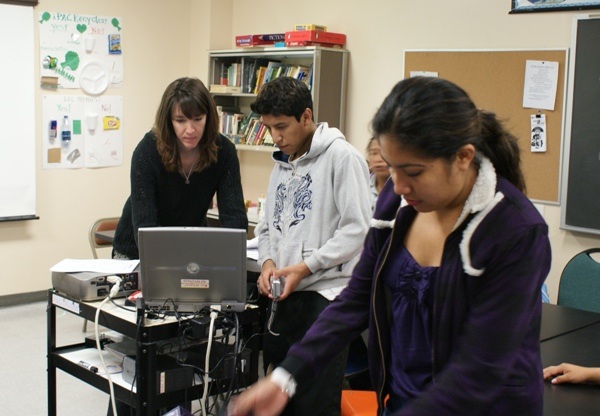
ESOL students make use of new technology to learn a new language. Photo by Sylvia Hernandez
ESOL students make use of new technology to learn a new language.Photo by Sylvia Hernandez

Its great that they take such initiative, said McAuliffe. Its really exciting and rewarding to see them succeed.

Although the majority are Hispanic students who are either local residents or who come from Mexico, this semester the program also includes international students from Vietnam, Brazil and Saudi Arabia.

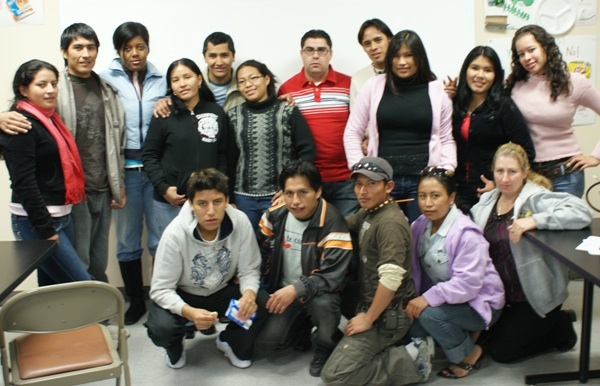
The ESOL students of the Fall 2008 semester. Photo by Sylvia Hernandez
The ESOL students of the Fall 2008 semester
Photo by Sylvia Hernandez

The Intensive English Program (IEP) is an academic prep course that uses the Focal Skills approach to teaching English. This approach uses a modular system that places students in the major language skill areas of Listening, Reading and Writing according to their assessed ability level, and it allows them to master each skill before moving on to the next. Each progressive skill incorporates the previous level for maximum learning potential.

Focal Skills is based on the belief that providing a wealth of comprehensible input leads to rapid acquisition of the target language. Students learn to speak and understand the language quicker than in traditional programs.

As part of the enrollment process, prospective students must take three tests. Students are then placed in classes according to their scores. Each student attends 12 hours of class and eight hours of lab each week, for up to four 4-week sessions per semester. Courses consist of Listening, Reading, Writing and Immersion.

Detailed information about each module can be found on the Palo Alto website along with international student applications, admissions checklists and tuition tables. The following excerpts preview each unit.

The Listening Module is the first in the series of IEP courses because the skill of listening is considered the critical foundation of acquiring the other language skills of reading, writing and speaking.

In the Reading Module, students read large quantities of authentic texts, explore vocabulary, practice reading skills, and discuss various topics they read about. Once students reach a score of 60 percent on the Focal Skills Reading Assessment, they may progress to the next level.

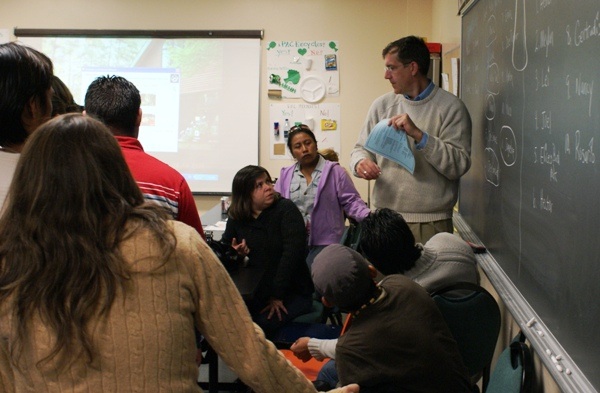
The ESOL students of the Fall 2008 semester. Photo by Sylvia Hernandez
The ESOL students of the Fall 2008 semester
Photo by Sylvia Hernandez

The Writing Module is the third course in the Intensive English Program. Because students ability to read is usually more advanced than their writing ability, they sharpen their writing through experience.

This module includes a large amount of writing every day to practice and automate the production of the common, high-frequency elements of written English they have acquired. Once students achieve a score of 75 percent on the Focal Skills Writing Assessment, they may then progress to the next module.

The Immersion Module is the fourth and final module. Students incorporate the use of all language skills in this course and carry out activities designed to prepare them for college success. They read numerous magazine and newspaper articles, essays and textbook excerpts to prepare them for the large amount of reading required in college classes. Writing activities include compositions, essays, journal writings, reports and a research paper. Speaking activities include oral summaries of articles, news reports, interviews, group discussions and formal speeches.

The Accuplacer is administered pre- and post-IEP to measure progress. College readiness is determined by the results of this test and an instructor assessment of the students overall work.

Palo Alto College also offers classes in English for Speakers of Other Languages (ESOL). These classes differ from the Intensive English Program. While the IEP is a 20-hour daytime program that meets four days per week, the ESOL classes meet at night. Students have the choice of registering for anywhere from three to 12 hours.

Palo Alto has been offering the Intensive English Program since 2004. The IEP has grown from 37 students the first year to 81 students today, including 20 from South America, who are here for a special eco-tourism program. An additional 30 students attend evening ESOL classes at Palo Alto.

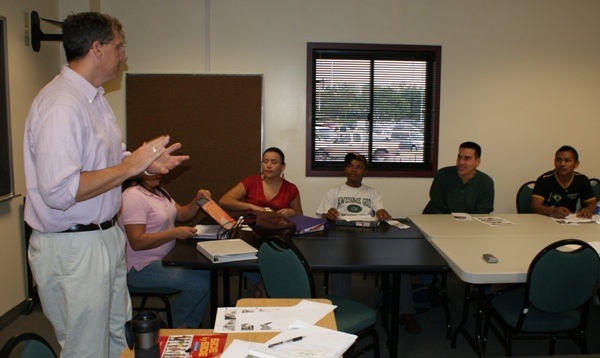
ESOL class in action. Photo by Sylvia Hernandez
ESOL class in action
Photo by Sylvia Hernandez
Either curriculum can be accessed through Continuing Education or college admissions. While a number of students are here on scholarships, financial aid is an alternative for many.

This semester Palo Alto College welcomed 20 students into the Intensive English Program from South America as part of the Indigenous Afro-Latino Scholarship Program (IALS), a two-year pilot program in Environmental and Cultural Tourism Studies.

The Alamo Community College District was one of only four higher education institutions selected to participate in this program.

The IALS Program, administered by Georgetown Universitys Center for Intercultural Education and Development (CIED), is the first program of its kind. It provides full scholarships for outstanding indigenous and Afro-Latino youth from Bolivia, Colombia, Ecuador and Peru for two years of post-secondary education at fully accredited universities and community colleges in the United States and Latin America.

Theyre here [at Palo Alto] on scholarships and they have one year to study English, McAuliffe said. Then they have one year to go to St. Philips College to study tourism because their field is Environmental Tourism.

Most of these students are first-time visitors to the United States. When they first arrived, they were filled with mixed emotions: fear, excitement and nervousness. On the one hand, they were thrilled to be among the elite group accepted into IALS program. On the other hand, they had to leave behind all that was familiar to them, especially their families, friends, food and culture. All of them understand that they are young ambassadors, and they are doing quite well in representing their countries.

Everything is so different, said Sandra Quinonez, an IALS student from Ecuador. The food was the hardest thing [to get used to].

A number of the students are from coastal countries where seafood is eaten regularly. In their new environment, they have gotten fairly comfortable with the available fast food restaurants.

In their spare time, the students study, bicycle and swim. The most common past time for the women was shopping. For the men, watching television was the winner.

I like [to watch] Family Guy or Fox Sports, said Joel Marrugo, an IALS student from Colombia.

The objective of the IALS Program is to reduce the existing barriers that prevent some students from accessing higher education by providing learning opportunities and technical training. The goal is to prepare and train them for entry-level jobs in fields that support broad-based economic development and environmental protection.

The program will also prepare students to be leaders in their home communities by involving them in community service projects and on-campus student government activities that will provide them with concrete skills applicable in their home countries.

Because our students are with the same group of students and the same teachers every day, this boosts their self confidence, McAuliffe said. They are really supportive of one another.

In the few months that they have been here, there has been tremendous improvement in their English. There is also no mistaking the camaraderie and closeness that the students share. When a question is posed to any particular student and he or she stumbles with the response, the rest rally around the student with encouragement and help until he or she is able to find the right words to express their response.

The students advance at different levels and all are learning fairly quickly.

One thing to keep in mind is that for many [of them], Spanish is not their first language, said Russell Wagner, Instructor of English for Speakers of Other Languages. Some have an indigenous first language and Spanish is their second.

Even within the same country, some students speak different dialects. Nico Suarez, Emira Montes and Maday Campos, IALS students from Peru, for example, speak Kechua, Kukama and Ashaninka, respectively.

Some of the students come from very rural areas, Wagner said. Coming here is quite a change for them.

McAuliffe said IEP students have group activities and potlucks every month to share a little bit of their own culture. They also have field trips throughout the entire year and an annual Christmas party. All of these activities help foster a closer relationship between the students and the teachers.

Students who successfully complete the entire IEP program and wish to continue their education are prepared to attend English language college courses.

Contact the ESOL Department at (210) 486-3230 or visit the Palo Alto website for more information.