Going green not just a dream: Reduce, Reuse, Recycle

By Lauren Cevallos
Pulse Staff Reporter

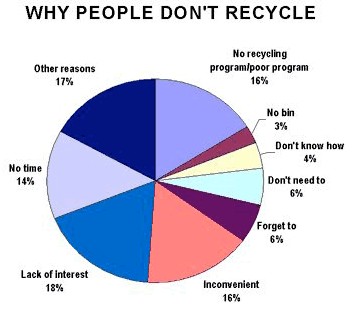
Graph: Why people don't recycle
http://www.ci.conover.nc.us/img/why_people_dont_recycle.png

For decades, those who discussed global warming, environmental issues and eco-friendly practices were labeled “tree huggers” or even “quacks”. What was once a topic for the minority has evolved into a mainstream call to action: to nurture the Earth back to health.

Evolving environmental education

The release of Al Gore’s 2006 Academy Award-winning documentary, “An Inconvenient Truth,” brought to light the daily actions that fuel global warming. The film pioneered a mass awareness in the general public, an outcome that Dr. Mary-Ellen Jacobs, Chairperson and Associate Professor of English, considers to be a milestone in the evolution of environmental awareness.

Jacobs believes that Gore’s loss in the 2004 Presidential Election was a “blessing”, because he was able to “put time and energy into environmental issues, his true passion.”

Gino Morales, the new president of Palo Alto’s Student Government Association (SGA), explained that the documentary is a wake-up call, and that it might spur contrite feelings.

The consensus among scientists is that we need to cut carbon emissions by 80 percent by 2050 (2 percent each year) to curb global warming.

It may surprise you to learn how much carbon dioxide you are emitting each year by driving your car and leaving your lights on. To calculate your carbon footprint, visit http://www.climatecrisis.org, and learn how to offset your carbon emissions.

Reincarnation works!

You are not required to practice Hinduism to believe in the power of reincarnation – environmental reincarnation that is. Recycling is one of the most familiar and popular eco-friendly practices to adopt.

Mother Earth has many children to provide for, about six billion in total. The speed at which people are using natural resources is faster than the Earth’s ability to regenerate them, so recycling is key.
Mathis Wackernagel, exec-utive director of Global Footprint Network, warned that the limit of the Earth’s endurance has already been reached, and he said that humanity is living off of an “ecological credit card”.

Wackernagel’s group estimated that it now takes one year and three months for our planet to regenerate what we use in one year, and that by 2050, the world’s population will demand twice as many resources as can be provided.

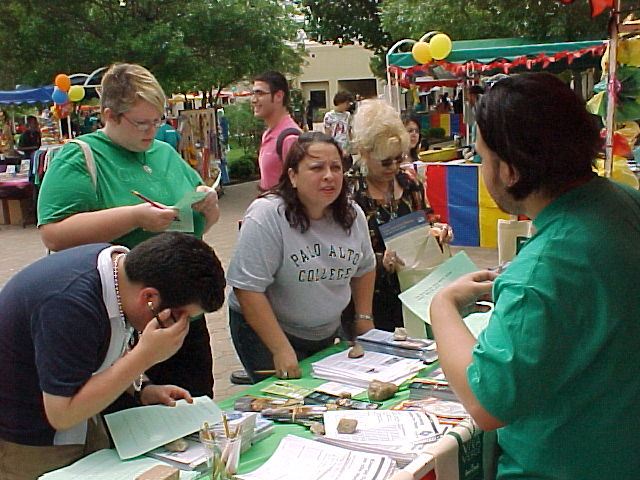
Go Green!¡Viva Verde! Committee teaches PAC green living at PACFEST.
Go Green! ¡Viva Verde! Committee teaches PAC green living at PACFEST. Photos by Dr. Denise Barkis Richter

Sandra Gonzalez-Lamb, a recruiter/adviser for the Recruitment and Community Outreach program, attends Alamo Community College recycling meetings and reports to the Palo Alto Go Green! ¡Viva Verde! Committee, a faculty/staff group that formed in January to make the campus more environmentally friendly. Palo Alto only recycles paper now, but the District is considering companies that recycle plastic, glass and aluminum, as well.

Gonzalez-Lamb has faith that a more comprehensive recycling program would bolster interested and involvement from students, faculty and staff, and she hopes to see these changes made within the year.

“I’m an educator at heart, so I think that if more people know how easily you can protect your environment, on a small or big scale, the better off we are,” she said.

Currently, money collected from the paper recycling program funds book scholarships.

The web site http://earth911.org is the largest information source for recycling locations and environmental resources. As a division of the cause media company Global Alerts, their content enables everyone to “think global, act local and make a difference.”

Small changes make a difference

As clothing, make up and office supply companies expand their product lines to offer consumers eco-friendly merchandise, “going green” looks more like a commercial trend.

Jacobs explained that teachers have an opportunity to help students understand how today’s issues affect them, and that the green movement should not be treated like a fad.

“Changing the way people think begins in the classroom, and it depends on how you teach…and incorporate those ideas to students,” said Jacobs, who integrates contemporary issues into the classroom and exposes her students to literature that “shows [them] different aspects of our world.”

The Go Green! ¡Viva Verde! Committee’s first step in making Palo Alto an eco-friendly campus was to adopt a Declaration of Environmental Sustainability.

The declaration comprises nine sub-areas, which committee members are asked to “investigate and implement”. The sub-areas range from reducing energy consumption and waste to protecting natural habitat and wildlife on campus.

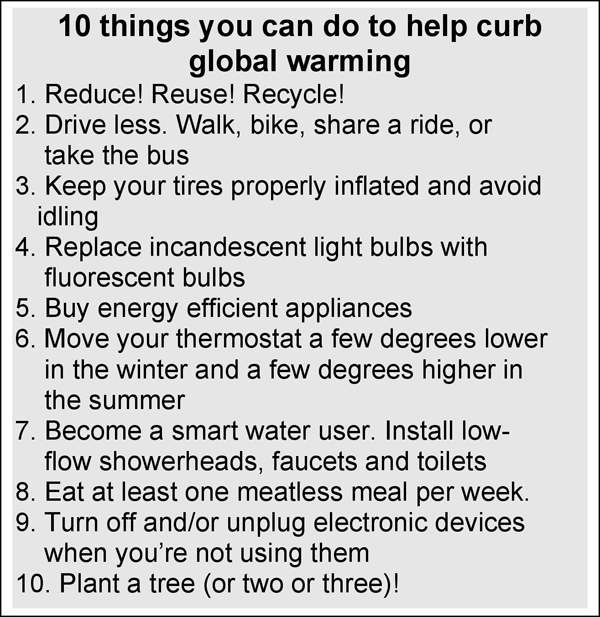
tips on going green
http://www.accd.edu/pac/htm/Community/publicaffairs/gogreen/default.htm

Jacobs said that the administration has been “extremely helpful” throughout this process, and they fully support the idea of environmental sustainability.

The Go Green! ¡Viva Verde! Committee, and Club Earth, a student organization, hosted an environmental information booth during the recent PACfest. More than 200 trees were given away, along with 500 reusable canvas bags and a variety of green information. Gonzalez-Lamb said that it is important to start small and build awareness.

“This is a brand new way of thinking for a lot of people,” she said. “Our goal is to educate the whole campus.”