Heart, dedication
and sleepless nights of hard work are what describe the 14 rural teachers
of Central America who have been on campus since January.
The course of study the teachers have had to take is an intensive 11-month
program that began in mid-January and ends in mid-December. Classes included
ESL (English as a Second Language), computer labs and leadership classes.
The teachers
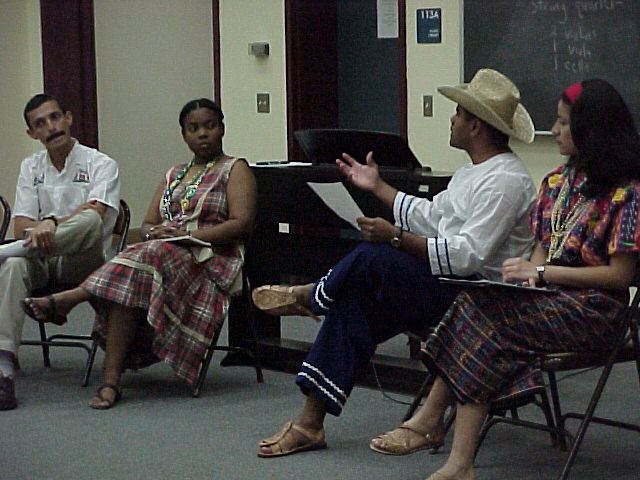
also took a child growth and development class.
"This has been a wonderful experience, because I got the opportunity to attend a school in the U.S., meet 13 people from other countries, learn about their cultures, their points of view and their ideas," said Leopoldo Caal, 27, a teacher for four years in Guatemala.
Participants include
Maklin Arriaza Gomez, Elena Chicas Vigil and Medardo Hernandez Iglesias
from El Salvador; Walter Urbina Mencia and Suyapa Ruiz Martinez from Honduras;
Susy Cordon Garcia, Cristina Cayetano Alvarez and Leopoldo Caal Alvarado
from Guatemala; Clementina Hernandez Sanchez, Maritza Morales Carrasco
and Francisco Montes Altamirano from Nicaragua; and Asterio Ramirez Garcia,
Omayra Trotman Castillo and Edelio Perez Morris from Panama.
The Cooperative Association of States for Scholarships was developed in
1985 by Congress. CASS is administered by Georgetown University to support
the socio-economic growth of disadvantaged communities in Central America.
Seventeen institutions of higher education in 11 states give scholarships
to about 200 students per year.
Julia Jarrell is the academic coordinator for CASS at Palo Alto, which
has been here for two years.
"Each student has to go through a very extensive election process
that requires a recommendation letter and an essay stating why they should
be chosen for this scholarship," said Jarrell. Another one of the
requirements is that they have to be rural teachers in a remote area and
have taught for at least three years.
CASS helps students
learn new things so that they may take what they have learned and help
others in their communities. CASS also allows them to view the political
aspect of another country. The current funding for this program is $10
million for 400 students (more than 300 two-year students and 50 one-year
students). CASS gives students from Panama, Nicaragua, El Salvador, Guatemala
and Honduras the opportunity to learn from each other.
The rural teachers are provided a scholarship to attend school. They also
obtain a visa to be able to stay here for one year. They all live in groups
of three or four at the Alta Vista Apartments. Each of them receives a
monthly stipend to purchase supplies, clothing or other things they need.
They get around town by bus.
"One of the things that I have enjoyed the most is having the opportunity
to live with other teachers and learn about their cultures and families.
It has been a very good experience for me, and I hope that I can deliver
what I have learned to other colleagues in my community," said Maklin
Arriaza, 33, a teacher of ten years from El Salvador.
Another part of the program is visiting different schools in different
areas of town. The CASS teachers have a chance to see the curriculum of
other schools and to see how students are taught. They also get to participate
in class by making lesson plans and teaching students. The school they
are currently working in is Burleson Elementary in the Edgewood District.
"One of the experiences that had the most effect on me was the student
teaching work we did at Burleson," said Clementina Hernandez, 38,
a teacher for 11 years in Nicaragua. "I learned new methods and techniques
that I can apply to my students and to my colleagues. I also had the opportunity
to see the ease teachers have in obtaining materials needed for their
classrooms. Sometimes we have to buy supplies from our paychecks for our
students."
Walter Urbina, 27, a teacher of eight years from Honduras, said, "I
feel like I have taken advantage of the courses that were offered. One
of my favorite classes was the leadership class because we not only deal
with students, we also deal with parents, community leaders and people
who are opposed to our ideas and the way we teach."
Several of the teachers left families behind. Asterio Ramirez, 31, a 10-year
teacher from Panama said, "It was a bit hard to leave my wife and
kids behind, but I feel fortunate to be here because this is the first
year that Panama participated. I come from an indigenous area, and we
are rarely given the opportunity to participate in programs like this
one, because everything is seen from a political aspect."
At home, these teachers get paid enough to feed their families. Sometimes
they have to get jobs on the side to bring in extra money.
"The only satisfaction we have is teaching the children so that they
will become better and help our community grow," said Arriaza.
These teachers will have a ceremony on Dec. 10 to obtain a certificate
of completion, and they will return home on Dec. 13. These rural teachers
have dedicated time and effort to this program, and they can’t wait
to go back to their country to begin new projects for their schools, students
and parents.
"I am very excited to go back to Guatemala," said Cristina Cayetano,
29, a teacher for eight years. "I have learned so many things that
I can teach my students and their parents. I will take many wonderful
memories of San Antonio, its people and CASS."