PAC Fencing Lunging forward
Pulse Staff Reporter
|
PAC Fencing Lunging forward |
|
| By Michelle
Meyer Pulse Staff Reporter |
|
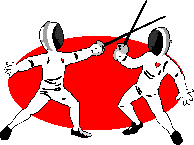
With swords drawn and just a few feet separating them, two competitors face each other prepared to duel. The command to fence is given, and the duel begins. This isn't a scene from a movie, but a scene from the Palo Alto College gym and the competitors are members of the fencing club here on campus. Students have several opportunities to learn to fence here at Palo Alto. Two fencing classes, beginning and intermediate fencing, are offered as part of the Physical Education curriculum. In these classes, students are introduced to and trained in foil. Palo Alto also has a fencing club. Vincent Bradford, a member of the 1984 U.S. Olympic fencing team and a five-time national champion in women's foil and women's epee, started the fencing club in September of 1997. In just two years, the club has grown from just a few members to 45 members. “It's great,” said Jesus Sanchez, a sophomore Criminal Justice major at Palo Alto and a fencing club member. “Everybody has dreamed or imagined sword fighting. It's like eating Ruffles. You can't eat just one.” Fencing is a sport made up of three weapons: epee, foil and saber. Epee is derived from the rapier, the sword used in real duels. The target area in epee fencing is the entire body. Today, a point is scored in epee when the tip of the sword touches anywhere on the body. Foil is derived from the teaching weapon used by the fencing masters. When fencing with the foil, only the torso is a target area. In foil, the fencer must follow the conventions of fighting, which simply means you must defend yourself if you are being attacked before you can launch an attack of your own. Saber is derived from the cavalry sword. Saber fencing is different from the other two weapons. A point is scored with cuts rather than thrusts. The edge of the sword is used to hit the target area, which is from the waist up. This is because if a man was sitting on a horse, the enemy didn't want to risk injuring the horse. Bradford has three goals for the college-level students in the club: to introduce students to fencing, to build a college-level fencing team, and to give students coaching opportunities. “It is very difficult to get Palo Alto College students involved in fencing.” said Bradford. “It takes several years to build a fencing culture.”
Not only are there top level coaches in the club, but there are also high level athletes. Students who join the club have the opportunity to not only train with these athletes, but to compete against them as well. Four students who have joined the club have not only advanced as athletes, but as coaches as well. Christopher Cox and John Guile, former Palo Alto students and Samantha Arnold, a sophomore Communications major and Sanchez have all moved up in the club to assistant coaches. The San Antonio Sports Foundation sends these students to Colorado Springs, Colo., every summer for coaching certification through the United States Fencing Association's Coaches College. This is a great opportunity for students to train with top coaches in the nation. The opportunity to coach while still learning to fence is beneficial for students. “You become a better fencer through coaching,” said Sanchez. “You become more technical being a coach.” The club is very focused on development and training. A student in the club will also learn in a “friendly, competitive, team environment,” according to Hurley. She said that is unique to be competitive and friendly, but the club is able to maintain a balance between the two. Once you become a member of the fencing club, there are many opportunities via tournaments to enter and advancements to be made. In the club, students can enjoy fencing “without the pressure of being successful” said Hurley. She doesn't mean success isn't stressed in the club, but that the individual's level of ability and not the level of ability of those around you measure success. Several members of the club are already experiencing success. Arnold, a member of the club since the beginning, is ranked third in this region, which consists of Texas, La., and Okla. This past summer she and Sanchez competed at the National Championships, which were held in Charlotte, N.C. For more information about the fencing program, call 921-5233 or check out their website at http://www.shardt.com/PACFC |
 The Palo Alto College Fencing Center,
the fencing clubs formal name, is working to build just such a culture
here at Palo Alto. The club boasts top-level coaches. Assisting Bradford
with the coaching duties are Wendell Kubik and Tracy Hurley. Kubik earned
his Master of Arms Certification in 1996 from the world renowned German
Fencing Academy and was the head fencing coach for the U.S. Air Force
Academy for four years; Hurley is a competitive fencer with more than
25 years experience at the local, regional and international levels.
The Palo Alto College Fencing Center,
the fencing clubs formal name, is working to build just such a culture
here at Palo Alto. The club boasts top-level coaches. Assisting Bradford
with the coaching duties are Wendell Kubik and Tracy Hurley. Kubik earned
his Master of Arms Certification in 1996 from the world renowned German
Fencing Academy and was the head fencing coach for the U.S. Air Force
Academy for four years; Hurley is a competitive fencer with more than
25 years experience at the local, regional and international levels.